
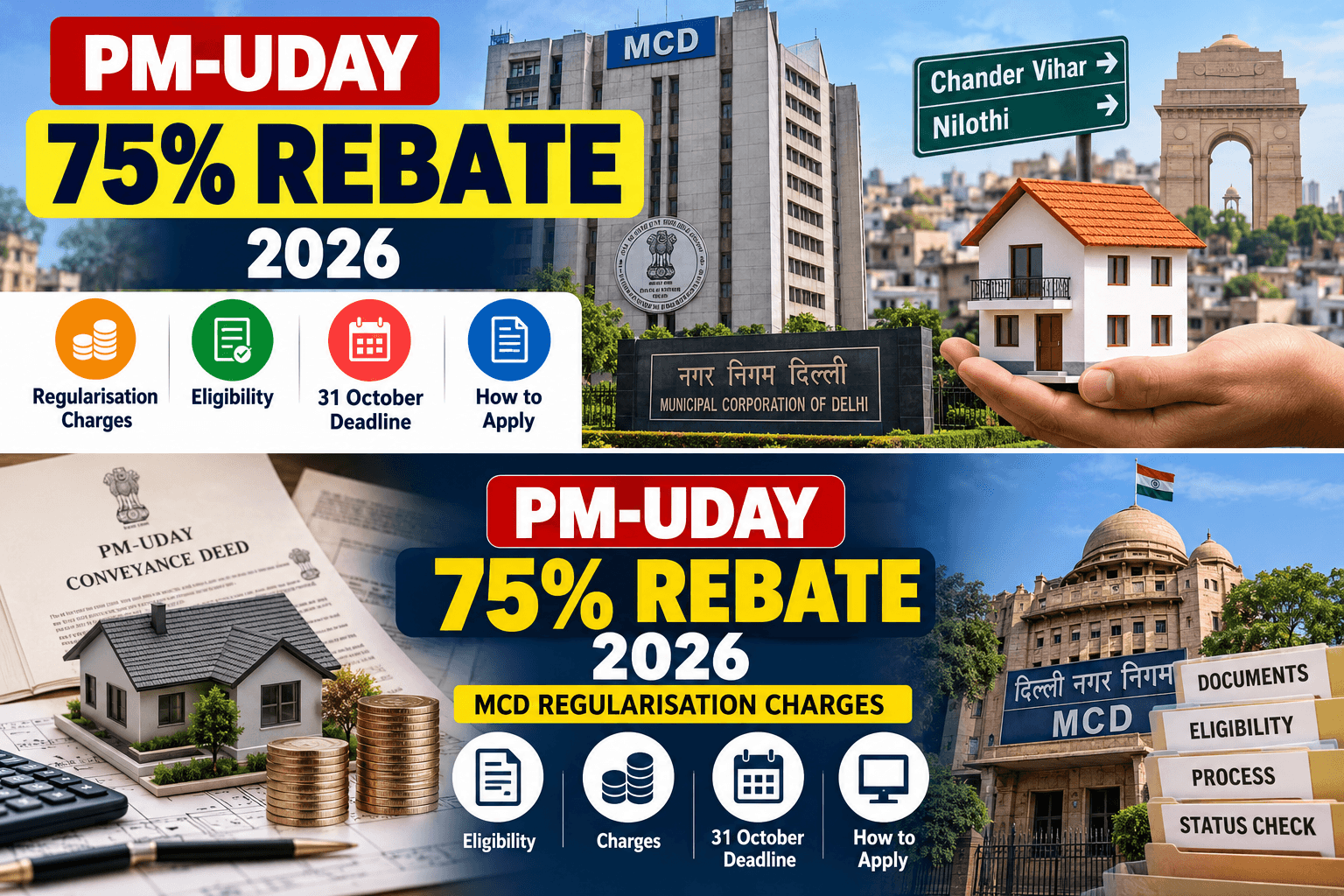
PM UDAY 75% Rebate 2026: MCD Regularisation Charges, Eligibility & 31 October Deadline
PM UDAY 75% Rebate 2026: Eligibility & 31 Oct Deadline
If you own a property in one of Delhi’s unauthorised colonies, there is an important update you should not ignore.
The Municipal Corporation of Delhi (MCD) has approved a 75% rebate on certain regularisation charges under PM-UDAY, and the current deadline is 31 October 2026. The relief is aimed at making regularisation more affordable for residents whose properties fall under the PM-UDAY framework. The Times of India
For residents of Chander Vihar, Nilothi and other eligible unauthorised colonies in Delhi, this can potentially reduce the cost of regularising the built-up portion of a property. But there are a few important conditions, and the rebate should not be confused with the separate charges paid to DDA for recognition of ownership rights under PM-UDAY.

What is the PM-UDAY 75% rebate?
The rebate is a concession announced by MCD on certain charges payable during the regularisation of eligible built-up properties in PM-UDAY colonies.
According to the latest announcement, the concession is available up to 31 October 2026. MCD officials have also said that it may continue beyond that date if the Delhi Government directs an extension, but property owners should not assume an extension will definitely happen. The Times of India
The safest approach is to treat 31 October 2026 as the current deadline.
Which properties can benefit?
The rebate is intended for eligible properties in unauthorised colonies covered by the 2026 regularisation framework.
An official MCD order dated 12 May 2026 states that 1,511 unauthorised colonies are to be considered for regularisation under PM-UDAY on an “as is, where is” basis, with 6 April 2026 as the cut-off date for residential use. It also states that construction existing on or before that date may be considered for regularisation under the framework. MCD Online
This means the location of the property alone is not enough.
The individual property still needs to satisfy the applicable eligibility, ownership and regularisation requirements.
Important: 6 April 2026 cut-off date
This is one of the most important points.
The MCD order says that construction existing on or before 6 April 2026 can be considered for regularisation on the “as is, where is” basis.
Any development after that date is governed by the applicable provisions of the Master Plan of Delhi 2021 and the Unified Building Bye-Laws 2016, as amended. MCD Online
So, simply constructing an additional floor or room after 6 April 2026 does not automatically bring that construction under the rebate or regularisation scheme.
What does “as is, where is” mean?
In simple terms, eligible existing construction is considered in the condition in which it stood at the relevant cut-off date.
However, it does not mean that every structure becomes legal automatically.
The MCD guidelines still contain conditions regarding ownership, FAR, roads, redevelopment and applicable building norms. For example, where the FAR exceeds permissible limits, the order provides for compounding at specified rates. MCD Online
So “as is, where is” should not be understood as “anything built is automatically approved.”
Which charges get the rebate?
Recent MCD reporting states that the 75% rebate applies to regularisation charges levied during the process of bringing eligible built-up properties into the regularisation framework. The Times of India
These are MCD-related regularisation charges.
This is important because many residents mix them up with DDA PM-UDAY ownership-right charges, which are separate.
PM-UDAY ownership charges and MCD regularisation charges are different
There are two different stages that people often confuse:
| Process | Authority | Main purpose |
|---|---|---|
| PM-UDAY ownership rights | DDA | Recognition of ownership, transfer and mortgage rights |
| Building/property regularisation | MCD/local body | Regularisation of eligible existing construction |
DDA separately calculates charges for recognition of ownership rights based on factors such as carpet area, land category and circle rate. DDA’s official FAQ provides formulas for these ownership-related charges and states that applicable charges have been enhanced annually by 8% from 1 April 2022. Delhi Development Authority
Therefore, the 75% MCD rebate should not be interpreted as a 75% discount on every PM-UDAY payment.
Who should check eligibility first?
Before paying any agent or professional, a property owner should check:
- whether the colony is included in the relevant PM-UDAY/regularisation list;
- whether the exact property falls within the recognised boundary;
- whether the property has the necessary ownership chain;
- whether a PM-UDAY Conveyance Deed or Authorisation Slip has been issued;
- whether the construction existed before the applicable cut-off date;
- whether there are any special restrictions affecting the plot.
DDA states that PM-UDAY covers 1,731 unauthorised colonies for recognition of ownership, transfer and mortgage rights. Delhi Development Authority
The 2026 MCD regularisation framework, however, refers to 1,511 colonies. MCD Online
That difference is another reason residents should verify their individual colony and property instead of assuming eligibility.
What about Chander Vihar and Nilothi?
For residents of Chander Vihar and Nilothi, the same rule applies: do not rely only on the locality name.
The correct check is whether the specific colony and the specific property fall within the notified PM-UDAY framework and relevant delineated boundary.
Two houses in the same broader area can have different documentation histories or boundary positions, so their eligibility may not be identical.
For Chander Vihar property owners, it is especially useful to keep the following ready:
- PM-UDAY Case ID
- Conveyance Deed or Authorisation Slip, if issued
- GPA/Agreement to Sell/Will or other ownership-chain documents
- electricity or water bills
- property-tax receipts
- GIS/property survey documents
- proof showing possession and construction history
DDA’s FAQ confirms that ownership-right applications can rely on documents such as sale deeds, gift deeds, GPA, Agreement to Sell, possession documents and evidence of consideration, depending on the case. Delhi Development Authority
Can someone with a GPA property benefit?
Possibly, but not automatically.
PM-UDAY was created specifically to address the long-standing problem of residents in unauthorised colonies lacking formal ownership, transfer and mortgage rights.
DDA accepts several types of property-chain documents for eligible applications. Delhi Development Authority
But the property still has to go through the prescribed process before a resident can assume that the building qualifies for MCD regularisation.
What if the PM-UDAY Conveyance Deed is already issued?
This is generally the stage where the property owner should investigate the MCD/SWAGAM regularisation process.
The Union Government announced in April 2026 that applications on the SWAGAM portal would be accepted for cases where the Conveyance Deed or Authorisation Slip had already been issued. Press Information Bureau
So, if your PM-UDAY ownership documentation is already complete, you may be in a better position to move to the next stage.
What if the Conveyance Deed or Authorisation Slip is still pending?
Then the PM-UDAY stage should be completed first.
The SWAGAM process does not replace DDA’s ownership-right process.
DDA states that even residents with a registered sale deed must follow the PM-UDAY procedure where applicable to obtain the relevant Conveyance Deed or Authorisation Slip. Delhi Development Authority
Does the rebate make regularisation cheap?
It can substantially reduce some applicable charges, but the final cost will depend on the property.
Recent reporting says that the rebate is intended to reduce the financial burden on residents and encourage more people to regularise their built-up properties. The Times of India
However, avoid anyone who promises a fixed amount such as:
“Your entire property will be regularised for only ₹10,000.”
The actual amount may depend on factors such as:
- property size;
- built-up area;
- FAR;
- colony category;
- existing violations;
- ownership status;
- applicable development/regularisation charges.
Why we are not giving ₹ figures for 50, 100 or 200 sq. yards here
It may be tempting to publish a simple table saying:
“50 sq. yards = ₹X”
“100 sq. yards = ₹Y”
But that could be misleading.
DDA ownership-right charges and MCD regularisation charges are separate, and the final amount can depend on more than plot size alone.
Until the exact current MCD calculation applicable to the particular property is known, it is safer to provide the official formula or actual assessment rather than a made-up estimate.
Can property owners apply online?
Yes, much of the PM-UDAY process is online.
DDA states that PM-UDAY applications are submitted online through its portal, and scrutiny is also carried out digitally through dedicated processing centres. Delhi Development Authority
For the regularisation stage, the Government announced the SWAGAM portal as the relevant route for eligible cases. Press Information Bureau
Documents you should keep ready
Before starting the process, keep digital copies of important property records.
A practical checklist includes:
- Aadhaar or other ID proof
- PM-UDAY Case ID
- Conveyance Deed/Authorisation Slip
- property address
- GPA
- Agreement to Sell
- Will, where applicable
- Possession Letter
- previous property-chain documents
- electricity bill
- water bill
- property-tax receipt
- GIS survey/key plan
- photographs of the property
- previous application receipts
The exact requirements can vary according to the property and application stage.
Is a house automatically safe from sealing after regularisation?
Do not assume so.
Regularisation, ownership rights and enforcement action are related issues, but they are not identical.
A property may still be affected by matters such as:
- new construction after the cut-off date;
- misuse of residential property;
- road or right-of-way issues;
- protected or prohibited land;
- serious building violations;
- unsafe structures.
DDA’s official FAQ lists several excluded/restricted land categories, including certain protected land, road rights-of-way, high-tension corridors, ridge areas and other legally protected areas. Delhi Development Authority
Does commercial use also get covered?
The May 2026 MCD order refers specifically to the regularisation framework with a residential-use cut-off date of 6 April 2026 and says the land use of plots/buildings in the covered unauthorised colonies is to be treated as residential for this process. MCD Online
Therefore, residents should not automatically assume that a commercial shop, warehouse or other non-residential use receives the same treatment.
Commercial-use questions should be checked separately against MCD and applicable planning rules.
What property owners should do before 31 October
If you believe your property may qualify, do not wait until the final few days.
A sensible sequence is:
Check colony → verify PM-UDAY status → confirm CD/AS → check property documents → verify construction cut-off → start MCD/SWAGAM process → obtain official charge calculation → claim applicable rebate
The current rebate deadline is 31 October 2026. The Times of India
Important warning for Chander Vihar residents
Do not hand over original property papers or large cash payments to someone simply because they say:
“PM-UDAY ka 75% discount chal raha hai, main property legal kara dunga.”
Ask for:
- official application number;
- government payment receipt;
- property assessment;
- professional registration details, where applicable;
- clear written breakup of government charges and professional fees.
Government charges and an agent/architect’s private professional fee are not the same thing.
Useful official links
| Purpose | Official source |
|---|---|
| PM-UDAY scheme | DDA PM-UDAY |
| PM-UDAY rules and 2026 amendment | DDA PM-UDAY Regulations |
| PM-UDAY FAQs and charges | DDA FAQs |
| SWAGAM regularisation process | MCD/SWAGAM |
| April 2026 regularisation announcement | Press Information Bureau |
The 2026 amendment and Gazette notification are available through DDA’s official PM-UDAY regulation section. Delhi Development Authority
Frequently Asked Questions
What is the PM-UDAY 75% rebate in 2026?
It is an MCD concession on certain regularisation charges for eligible built-up properties covered by the PM-UDAY regularisation framework. The Times of India
What is the last date?
The currently announced deadline is 31 October 2026. The Times of India
Will the deadline definitely be extended?
No confirmed extension should be assumed. MCD officials have indicated that an extension could occur if directed by the Delhi Government, but the current deadline remains 31 October. The Times of India
Is this a 75% discount on all PM-UDAY charges?
No. DDA ownership-right charges and MCD regularisation charges are different.
What is the construction cut-off date?
The MCD’s May 2026 guidelines state that construction existing on or before 6 April 2026 may be considered under the “as is, where is” regularisation framework. MCD Online
Can a newly built floor after April 2026 get regularised automatically?
No. Development after the cut-off date is subject to the applicable Master Plan and building bye-laws. MCD Online
Do I need PM-UDAY documents before SWAGAM?
The 2026 government process provides for SWAGAM applications in cases where the relevant PM-UDAY Conveyance Deed or Authorisation Slip has been issued. Press Information Bureau
Conclusion
The PM-UDAY 75% rebate 2026 can be a meaningful opportunity for eligible property owners in Delhi’s unauthorised colonies, especially for families who delayed regularisation because of the cost.
But the most important thing is to understand what the rebate actually covers.
It does not mean every property has suddenly become legal, and it does not replace the PM-UDAY ownership-right process.
For residents of Chander Vihar and Nilothi, the best approach is to verify the exact property status, complete the PM-UDAY documentation where required and then use the official MCD/SWAGAM process for regularisation.
With the present deadline set for 31 October 2026, eligible property owners should check their case early rather than waiting until the final week.
हिंदी में समझें: PM-UDAY 75% Rebate 2026
अगर आपका घर या प्रॉपर्टी दिल्ली की अनधिकृत कॉलोनी में है, तो PM-UDAY और MCD Regularisation से जुड़ा 2026 का अपडेट आपके लिए महत्वपूर्ण हो सकता है।

सरकार ने 2026 में 1,511 योग्य अनधिकृत कॉलोनियों में मौजूद eligible residential construction को “as-is, where-is” basis पर regularisation framework में शामिल किया है. Press Information Bureau
PM-UDAY क्या करता है?
PM-UDAY मुख्य रूप से property के:
- ownership rights,
- transfer rights,
- mortgage rights
को recognise करने के लिए बनाया गया है.
DDA के अनुसार PM-UDAY ownership-right framework 1,731 unauthorised colonies को cover करता है. Delhi Development Authority
MCD Regularisation क्या है?
MCD regularisation का उद्देश्य eligible built-up property की building/construction regularisation process को पूरा करना है.
इसका मतलब यह है कि:
PM-UDAY ownership rights और MCD building regularisation दो अलग लेकिन जुड़े हुए steps हैं.
SWAGAM पर कब apply कर सकते हैं?
अगर आपका PM-UDAY Case ID है और आपका Conveyance Deed या Authorisation Slip जारी हो चुका है, तो eligible case में SWAGAM application आगे बढ़ सकता है. Press Information Bureau
Simple process:
PM-UDAY Case ID → Conveyance Deed/Authorisation Slip → SWAGAM → MCD Regularisation
6 अप्रैल 2026 की तारीख क्यों जरूरी है?
MCD के 2026 order में eligible residential construction के लिए 6 April 2026 cut-off date दी गई है. MCD Online
इसलिए 6 अप्रैल 2026 के बाद की गई नई construction, extra floor या major alteration को automatically regularised नहीं माना जाना चाहिए.
Chander Vihar / Nilothi वालों को क्या check करना चाहिए?
अगर आपकी property Chander Vihar या Nilothi में है, तो केवल area का नाम देखकर eligibility assume न करें.
आपको check करना चाहिए:
- colony official list में है या नहीं;
- property delineated boundary में आती है या नहीं;
- PM-UDAY Case ID बना है या नहीं;
- Conveyance Deed / Authorisation Slip जारी हुआ या नहीं;
- property किसी restricted land category में तो नहीं है;
- construction cut-off date से पहले मौजूद थी या नहीं.
कौन से documents ready रखें?
- PM-UDAY Case ID
- Conveyance Deed / Authorisation Slip
- Aadhaar
- GPA
- Agreement to Sell
- Possession Letter
- Sale/Gift Deed, जहां applicable हो
- electricity/water bill
- property tax receipt
- GIS/property documents
- SWAGAM application receipt
सबसे जरूरी सावधानी
किसी agent के सिर्फ इस वादे पर भरोसा न करें कि:
“75% rebate है, आपकी पूरी property legal हो जाएगी.”
पहले DDA/MCD के official records और अपने property documents verify करें.
Government charges, regularisation charges और private professional fee अलग-अलग हो सकते हैं.
Quick Hindi Summary
योजना: PM-UDAY / MCD Property Regularisation
Area: Eligible unauthorised colonies of Delhi
Eligible colonies under 2026 regularisation framework: 1,511 Press Information Bureau
PM-UDAY ownership-right coverage: 1,731 colonies Delhi Development Authority
Important cut-off: 6 April 2026 MCD Online
SWAGAM applications: from 24 April 2026 for eligible CD/AS-issued cases Press Information Bureau
Best advice: पहले eligibility और documents verify करें, फिर application/payment करें.
Conclusion
The PM-UDAY 75% rebate 2026 can reduce the financial burden for eligible Delhi property owners, but it should be understood as part of the larger PM-UDAY and MCD regularisation framework.
For residents of Chander Vihar and Nilothi, the safest sequence is:
Verify colony → check PM-UDAY status → obtain CD/AS → check construction eligibility → apply through SWAGAM/MCD → confirm charges and rebate → complete regularisation.