
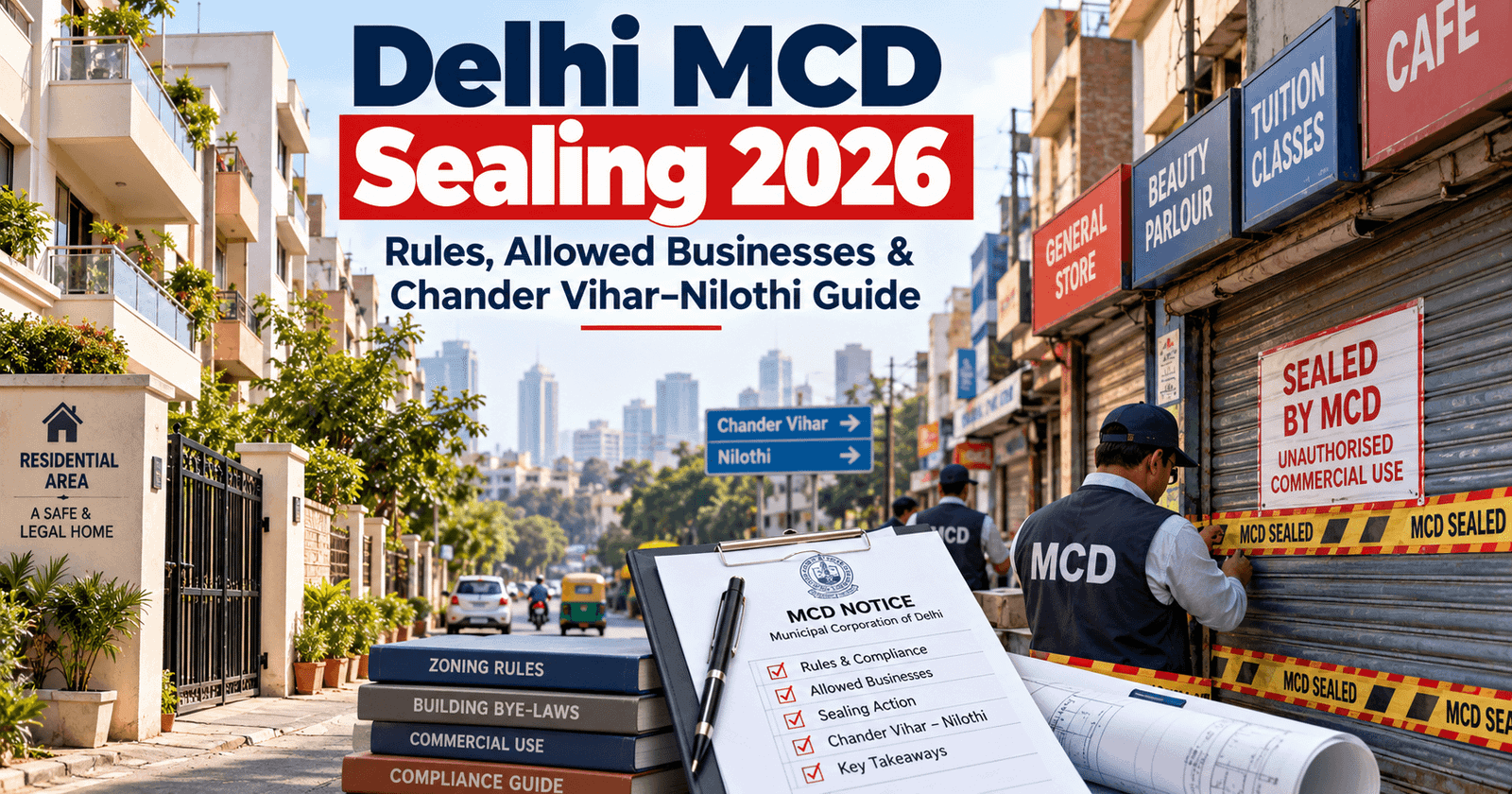
Delhi MCD Sealing 2026: Important Rules, Risks & Chander Vihar Guide
Delhi MCD Sealing 2026: Property Rules, Allowed Businesses, Master Plan & Chander Vihar–Nilothi Guide
If you own a house, shop or commercial establishment in Delhi, you may have recently heard people discussing MCD sealing, demolition notices and unauthorised construction.

Questions are common:
Can MCD seal a residential house?
Can a commercial shop also be sealed?
Is an advocate’s office allowed in a residential property?
What about a food shop, restaurant, car-washing centre or bike-repair workshop?
How many floors can be constructed on a 50-gaj, 100-gaj or 200-gaj plot?
And for residents of Chander Vihar and Nilothi Extension, there is another important question:
What is the status of our colony, particularly after PM-UDAY and the latest regularisation developments?
This guide explains these issues in simple language.
Why Is MCD Sealing Again in the News in Delhi?
Delhi has seen a significant enforcement drive against unauthorised and unsafe construction in 2026.
Following the September 2026 building collapse in Satya Niketan, MCD intensified inspections and action across Delhi. According to a compliance affidavit reported on September 25, MCD had demolished 543 properties and sealed 178 properties between September 6 and September 23, while also issuing hundreds of show-cause notices.
A separate MCD status report submitted to the Supreme Court reportedly stated that almost 1,100 unauthorised structures had been demolished in approximately three months, while action had also been initiated against thousands of properties for commercial misuse of residential premises.
This means MCD action is not limited to one locality or one type of building.
It may involve:
- unauthorised construction;
- additional floors;
- structurally unsafe buildings;
- misuse of residential property;
- commercial activity not permitted at that location;
- construction contrary to a sanctioned building plan; or
- violations of the Master Plan or Building Bye-Laws.
What Does MCD Sealing Actually Mean?
People often use the words sealing, demolition and booking as though they mean the same thing. They do not.
Booking of a property
MCD records an alleged unauthorised construction or violation in its system and may initiate proceedings.
Show-cause notice
The owner or occupier is asked to explain why action should not be taken.
Sealing
Access to all or part of a property may be physically sealed so that the premises or offending portion cannot be used.
Demolition
The unauthorised portion may be removed or demolished.
MCD’s own 2025 directions state that actions involving booking, sealing, demolition, prosecution, requests for electricity/water disconnection and other unauthorised-construction proceedings are to be maintained electronically. MCD also says booked-property information should be placed in the public domain.
MCD currently provides an online “Unauthorised Construction Property Details” service.
Can MCD Seal a Residential House?
Yes.
A residential property is not automatically protected from sealing merely because a family lives there.
For example, action may arise where:
- an unauthorised floor has been constructed;
- construction exceeds the sanctioned plan;
- required setbacks have been covered illegally;
- a dangerous or structurally unsafe building has been created;
- a residential building is being commercially misused; or
- a non-permitted business is operating from the property.
However, a normal residential house constructed and used according to the applicable building rules should not be confused with an unauthorised property simply because neighbouring properties have violations.
Can a Commercial Property Also Be Sealed?
YES.
Being a commercial shop does not make a property immune from MCD action.
A commercial establishment may face enforcement if, for example:
- the building itself contains unauthorised construction;
- the business is operating in an area where that activity is not permitted;
- a basement is being used contrary to its permitted use;
- mandatory permissions are absent;
- a commercial activity is being conducted beyond the area permitted under mixed-use rules.
A recent example came from Chandni Chowk, where MCD sealed 54 jewellery shops operating from basements in September 2026. The reported sealing order cited commercial use of basements contrary to the permitted use under MPD-2021.
So the important question is not simply:
“Residential or commercial?”
The better questions are:
What is the sanctioned use of the property?
What construction has been approved?
What activity is actually being carried out?
Delhi Master Plan 2021 or Master Plan 2041: Which One Applies?
This is an important point because many people refer to the Delhi Master Plan 2041 as though it has already completely replaced MPD-2021.
As of October 2026, DDA’s official website still describes it as the:
“Master Plan for Delhi – 2041 (Draft)”.
Therefore, residents should not assume that every proposal contained in Draft MPD-2041 is already an enforceable permission.
For current property and mixed-use questions, MPD-2021, its amendments, Unified Building Bye-Laws and subsequent notifications/orders remain highly relevant.
What Is “Lawful Construction”?
A lawful building is not simply a building that “looks similar to the other houses in the street”.
A building generally has to comply with applicable requirements concerning:
- permissible ground coverage;
- FAR;
- building height;
- setbacks;
- number of dwelling units;
- sanctioned building plan;
- structural safety;
- permissible use; and
- applicable Building Bye-Laws.
A neighbour having constructed five floors does not automatically give another owner the right to construct five floors.
Similarly:
“Everybody in our gali has extended their balcony”
does not by itself make an unauthorised balcony legal.
50-Gaj, 100-Gaj and 200-Gaj House: Simple Examples
Delhi Master Plan development-control tables use square metres, so first let us convert commonly used Delhi plot sizes.
50 square yards
Approximately 41.8 sq. metres.
This generally falls in the MPD category of plots above 32 sq. m and up to 50 sq. m.
The published MPD-2021 norms show:
- Maximum ground coverage: 90%
- FAR: 350
- Maximum dwelling units: 3
- General maximum building height: 15 metres
100 square yards
Approximately 83.6 sq. metres.
This generally falls in the above 50 sq. m to 100 sq. m category.
The MPD table provides:
- Maximum ground coverage: 90%
- FAR: 350
- Maximum dwelling units: 4
- General maximum building height: 15 metres
For future construction on residential plots between 50 and 100 sq. metres, the published MPD provisions also refer to a minimum 2 m × 2 m open courtyard.
200 square yards
Approximately 167.2 sq. metres.
This falls within the category above 100 sq. m and up to 250 sq. m.
The published MPD development controls show:
- Maximum ground coverage: 75%
- FAR: 300
- Maximum dwelling units: 4
- General maximum height: 15 metres
For plots above 100 sq. m and up to 250 sq. m, the published setback table specifies a 3-metre front setback, subject to the applicable layout and other provisions.
Does a 15-Metre Height Limit Mean You Can Automatically Build Four or Five Floors?
No.
This is one of the most important misunderstandings.
MPD-2021 states a general maximum height of 15 metres for these residential plots.
But:
15 metres is a height limit. It is not by itself permission to construct any number of floors you want.
For example, a building could remain below 15 metres but still violate:
- FAR;
- ground coverage;
- sanctioned floor plan;
- setback requirements;
- structural requirements; or
- dwelling-unit limits.
So saying:
“My building is only 14.5 metres high, therefore everything is legal”
would not necessarily be correct.
All applicable rules have to be considered together.
Is a Balcony Allowed?
A balcony is not automatically illegal.
But it is also not automatically legal simply because the plot owner wants one.
A balcony should comply with the sanctioned building plan and applicable projection/open-space requirements.
For example:
Example 1 – Generally lawful
Your sanctioned building plan shows the balcony in its approved position and dimensions, and construction matches that plan.
Example 2 – Potentially unauthorised
The sanctioned plan shows a smaller balcony but, during construction, the balcony is extended another 2 or 3 feet towards the street.
Example 3 – Serious problem
A balcony, room or slab is extended over a public road, public land or lane without lawful authority.
Construction encroaching on public land should not be treated as automatically regularisable merely because similar encroachments exist elsewhere.
Legal Construction vs Unauthorised Construction: Easy Examples
| Situation | General position |
|---|---|
| Building matches sanctioned plan | ✅ Generally lawful |
| Approved balcony constructed according to plan | ✅ Generally lawful |
| Additional unauthorised floor | ❌ Can face enforcement |
| Balcony later extended beyond sanctioned dimensions | ⚠️ May be unauthorised |
| Construction exceeding permissible FAR | ❌/⚠️ Requires examination; may attract enforcement/regularisation rules where applicable |
| Construction inside a required setback | ⚠️ Depends on applicable provisions |
| Encroachment onto public road/public land | ❌ Serious violation |
| Building below 15 m but exceeding FAR | ❌ Height alone does not make it lawful |
| Property rights under PM-UDAY | ✅ Relevant to ownership/property rights |
| PM-UDAY property with illegal new construction | ❌ PM-UDAY does not automatically legalise every later construction |
What About Chander Vihar, Nilothi Extension?
This is especially relevant for readers of demo.chandervihar.in/.
Official DDA records specifically identify:
Nilothi Extn., Nangloi, Delhi-41 — Registration No. 879
within DDA’s delineated-boundary records for unauthorised colonies.
DDA records also specifically mention Chander Vihar, Nilothi Extn., Delhi-41 in the Zone K-I planning material.
Even more directly, DDA previously organised a PM-UDAY facilitation camp at:
Chander Vihar, Nilothi Extension, Colony Registration No. 879, New Delhi-110041.
This confirms that Chander Vihar/Nilothi Extension has a direct connection with the PM-UDAY/unauthorised-colony framework.
However, this should not be interpreted as:
“Every house in Chander Vihar is automatically completely regularised.”
The exact plot must still be checked against the applicable delineated boundary and property records.
A Major 2026 Development for Unauthorized Colonies
This is particularly important for Chander Vihar residents.
MCD issued directions in May 2026 regarding regularisation of properties falling in 1,511 unauthorised colonies listed under PM-UDAY, pursuant to the Gazette notification dated April 6, 2026.
The MCD document states that, for this regularisation process:
land use of plots/buildings in covered unauthorised colonies is to be treated as residential, while eligible construction existing on or before April 6, 2026 is to be considered for regularisation on an “as is, where is” basis.
Importantly, the same directions state that development taking place after April 6, 2026 is governed by MPD-2021 and Unified Building Bye-Laws 2016, as amended.
That date could therefore become extremely important for residents contemplating new construction.
PM-UDAY Does Not Mean “Anything Can Be Built”
This deserves special attention.
There are three different questions:
1. Do you have recognised property rights?
PM-UDAY may be relevant.
2. Is your building construction regularised or sanctioned?
That is a separate building-control question.
3. Is your business/activity legally permitted at that location?
That is again a separate land-use/mixed-use/licensing question.
In simple words:
Property ownership ≠ building approval ≠ commercial permission.
Having one does not automatically give you all three.
Which Businesses Are Generally Allowed and Which Can Face Problems?
This is where Delhi’s mixed-use rules become important.
DDA currently explains that certain commercial/professional activities can operate from residential premises subject to conditions, while several nuisance-producing or incompatible activities are specifically prohibited.
Here is a simple guide.
| Activity | General position | Important condition |
|---|---|---|
| Advocate/lawyer office | ✅ Generally permissible professional activity | Area/use limits and other MPD conditions apply |
| Chartered Accountant office | ✅ Generally permissible | Professional-activity conditions apply |
| Architect office | ✅ Generally permissible | Professional-activity conditions apply |
| Doctor/consultation activity | ✅ Generally permissible subject to applicable provisions | Exact nature/size of activity matters |
| Professional engineer/consultant | ✅ Generally permissible | MPD limits apply |
| Kirana/general store | ✅/⚠️ Can be permitted | Ground floor, area and mixed-use provisions matter |
| Bakery/confectionery | ✅/⚠️ Can be permitted | Applicable shop/licensing rules still apply |
| Vegetable/fruit shop | ✅/⚠️ Can be permitted | Location and mixed-use conditions apply |
| Chemist | ✅/⚠️ Can be permitted | Drug/business licences also required |
| Salon/barber | ✅/⚠️ Can be permitted | Applicable mixed-use/licensing conditions |
| Small food shop | ✅/⚠️ Conditional | Depends on exact activity |
| Restaurant | ⚠️ Conditional | Location, mixed-use street, licences, fire and other conditions can apply |
| Cloud kitchen | ⚠️ Needs individual checking | Cooking, exhaust, fire, pollution and land-use issues may apply |
| Car repair workshop | ❌ Generally not permissible as ordinary residential mixed use | Limited location-specific exceptions may exist |
| Bike/scooter repair workshop | ❌ Generally not permissible under ordinary mixed-use provisions | Exact road/location classification matters |
| Tyre retreading | ❌ Listed as non-permissible | — |
| Battery charging | ❌ Listed as non-permissible | — |
| Welding/fabrication | ❌ Generally non-permissible | Nuisance/pollution considerations |
| Godown/warehouse | ❌ Generally non-permissible | Separate permitted land use may be necessary |
| Junk shop | ❌ Generally non-permissible | Applicable exceptions, if any, need checking |
| Manufacturing | ❌ Generally not permitted | Permitted household industry is treated separately |
| Car/bike washing centre | ⚠️/❌ Should not be assumed permissible in an ordinary residential property | Land use, water-intensive activity, drainage, nuisance and other permissions require examination |
DDA’s official mixed-land-use guidance specifically identifies automobile repair/workshops, cycle-rickshaw repairs, tyre retreading, battery charging, certain flour mills, fabrication/welding, storage/godowns, warehousing, manufacturing other than permissible household industry and junk shops as non-permissible mixed-land-use activities.
Is an Advocate’s Office Allowed in a Residential Property?
This is different from running an ordinary commercial shop.
Professional activities are specifically recognised within Delhi’s mixed-use framework.
DDA says professional offices can operate up to 25% of FAR or 100 sq. metres, whichever is less, subject to the applicable provisions.
Therefore, activities such as an advocate’s professional office should not automatically be equated with an automobile workshop or industrial activity.
The exact property and use should still comply with the relevant provisions.
Is Food Business Allowed?
The answer is:
It depends on the type of food business.
A kirana store, bakery, sweet shop, food outlet and full restaurant are not necessarily treated exactly the same way.
For example:
Small bakery or food shop
May fall within permitted retail/mixed-use categories subject to the applicable conditions.
Restaurant
May require the property to satisfy mixed-use/commercial-street requirements in addition to licences and other statutory approvals.
Cloud kitchen
A cloud kitchen can involve:
- LPG/cooking installations;
- chimney/exhaust;
- fire safety;
- waste disposal;
- delivery traffic;
- pollution/nuisance issues.
Therefore, someone should not conclude:
“Food is allowed, so every restaurant or cloud kitchen is automatically allowed from any house.”
What About Car or Bike Washing?
A car/bike washing centre should not automatically be treated as an ordinary permitted neighbourhood shop.
Why?
Because such a business can involve:
- substantial water consumption;
- wastewater;
- detergents/chemicals;
- vehicles occupying the street;
- drainage problems;
- commercial activity extending outside the premises; and
- nuisance to neighbouring residents.
Vehicle repair and automobile workshops are specifically identified by DDA among non-permissible mixed-land-use activities in ordinary residential areas.
Therefore, a car or bike washing/service centre should be checked against the specific land use and permissions for that property rather than assuming that it is allowed simply because it is operating from a shop.
Why Is One Shop Sealed While Another Shop Next Door Remains Open?
This is one of the most common questions residents ask.
Two neighbouring shops can have completely different legal situations.
Authorities may consider:
- Whether the street is residential, mixed-use or commercial.
- Whether that particular business activity is permitted.
- Plot size.
- Road width.
- Ground-floor or upper-floor use.
- Amount of commercial area.
- Sanctioned building plan.
- Unauthorised construction.
- Encroachment.
- Conversion/mixed-use charges where applicable.
- Health/trade licence.
- FSSAI approval for food establishments.
- Fire-safety requirements.
- Pollution or nuisance issues.
- Basement usage.
Therefore:
“The shop opposite mine is doing the same thing” is not proof that either property is legally compliant.
Retail Shops in Residential Premises
DDA’s current mixed-use guidance states that retail shops, other than hazardous or nuisance-causing activities, may operate in residential premises up to:
25% of ground-floor coverage or 50 sq. metres of floor area, whichever is less, subject to the applicable mixed-use framework.
This is another reason why the question is not simply:
“Can I open a shop?”
You also need to ask:
How much area can be used? On which floor? What type of shop? And is the location eligible?
What Should You Do If You Receive an MCD Notice?
First: do not ignore it.
Check:
- property number and address;
- name of issuing authority;
- notice date;
- alleged violation;
- section of law mentioned;
- reply/hearing date; and
- whether sealing, demolition or misuse proceedings are involved.
Then collect available documents such as:
- ownership documents;
- PM-UDAY documents, if applicable;
- sanctioned building plan;
- old building drawings;
- property-tax records;
- electricity/water documents;
- photographs showing the age of construction;
- structural-safety documents, where applicable;
- business/trade licences; and
- any previous MCD orders.
Where necessary, consult an architect familiar with Delhi Building Bye-Laws and a lawyer dealing with MCD/property matters.
Never Break an MCD Seal Yourself
This is important.
If MCD has formally sealed a property, do not simply remove the seal and start using the premises again.
MCD’s official directions state that where seals are tampered with, an FIR should be lodged.
Legal de-sealing or relief should be sought through the applicable authority or legal process.
How Can You Check Whether a Property Is Booked by MCD?
MCD currently provides an online:
Unauthorised Construction Property Details
service through its official portal.
Residents should prefer official records rather than relying entirely on:
- property dealers;
- neighbours;
- WhatsApp forwards;
- unofficial colony lists; or
- statements such as “nothing will happen here”.
What Chander Vihar–Nilothi Residents Should Check Before New Construction
If you own a plot in Chander Vihar/Nilothi Extension and are planning new construction or an additional floor, first check:
- whether your property falls within the relevant delineated PM-UDAY boundary;
- your PM-UDAY/property-right status;
- whether existing construction is eligible under the 2026 regularisation framework;
- construction date;
- plot dimensions;
- road width;
- applicable FAR;
- permissible ground coverage;
- setbacks/open spaces;
- height;
- structural safety; and
- whether a building plan/regularisation application is required.
This is particularly important because MCD’s 2026 regularisation directions distinguish construction existing on or before April 6, 2026 from later development. Later development is stated to be governed by MPD-2021 and Unified Building Bye-Laws 2016, as amended.
Before Starting a Business in Chander Vihar, Ask These Five Questions
Before paying rent or spending money on interiors, machinery or a shop setup, ask:
1. What is the recognised land use of the property?
2. Is this particular business activity permitted there?
3. Is the building itself compliant or eligible for regularisation?
4. Are trade, food, fire, pollution or other licences required?
5. Am I occupying any road, pavement, setback or public space?
Checking these questions first can be far cheaper than dealing with sealing proceedings later.
Frequently Asked Questions
Can MCD seal a completely residential house?
Yes, if there is an actionable violation such as unauthorised construction, unsafe construction or another breach of applicable law. Merely being residential does not provide immunity.
Can MCD seal a commercial property?
Yes. Commercial premises can also be sealed for unauthorised construction, misuse or activity contrary to permitted use.
Does PM-UDAY mean my building is completely legal?
Not necessarily. Property-right recognition, building regularisation and permission for a particular commercial activity are separate matters.
Is Chander Vihar covered under PM-UDAY?
Official DDA material specifically associates Chander Vihar, Nilothi Extension with Colony Registration No. 879 / Nilothi Extension, Nangloi. However, an individual plot should still be checked against the official delineated boundary and records.
Can I construct four floors on a 100-gaj plot?
Do not decide solely by counting floors. A roughly 100-gaj plot falls within the MPD category carrying 90% maximum ground coverage and FAR 350, with a general 15-metre maximum height, but the complete applicable building controls and sanctioned plan must still be followed.
Is a balcony legal?
A balcony complying with the sanctioned building plan and applicable Building Bye-Laws can be lawful. An unauthorised extension beyond permitted dimensions can create a violation.
Is an advocate’s office allowed?
Professional office use is recognised under Delhi’s mixed-use framework, subject to applicable limits and conditions. DDA states that professional offices can use up to 25% of FAR or 100 sq. metres, whichever is less.
Is a car-repair shop allowed in a residential house?
Automobile repair/workshops are specifically included by DDA among activities generally not permitted under ordinary residential mixed-land-use provisions, though specific location-based provisions may need examination.
Can a food shop operate in a residential locality?
Certain retail activities can be permitted subject to mixed-use rules. A small food shop, restaurant and cloud kitchen should not automatically be treated as the same use.
Can I break an MCD seal after receiving a stay or application receipt?
Do not remove a seal yourself merely because an application or representation has been filed. Follow the formal de-sealing/order process. MCD instructions call for an FIR where seals are tampered with.
Final Word for Chander Vihar Residents
Delhi’s property rules can be confusing because several different issues are often mixed together: ownership, PM-UDAY, regularisation, sanctioned construction, Master Plan land use and commercial permission.
The simplest way to remember it is:
Owning the property does not automatically legalise every construction.
Legal construction does not automatically permit every business.
And seeing the same construction or business next door does not automatically make yours legal.
For Chander Vihar and Nilothi Extension in particular, the 2026 PM-UDAY regularisation developments are significant. At the same time, anyone planning new construction after April 6, 2026, adding floors, extending balconies or starting a commercial establishment should check the latest MCD/DDA rules applicable to the particular plot before proceeding.
The safest approach is simple: check first, construct or invest later.
Disclaimer
This article is intended for general public awareness and local-information purposes. Delhi building, land-use, mixed-use and regularisation rules can depend on the exact property, colony boundary, sanctioned plan, construction date, road width and nature of use. It should not be treated as individual legal or architectural advice. Property owners should verify their specific case with the relevant MCD/DDA authority and, where required, a qualified architect or legal professional.
Useful Official Links
| Purpose | Official Link |
|---|---|
| Municipal Corporation of Delhi (MCD) | MCD Official Website |
| Check Unauthorised Construction Property Details | MCD Unauthorised Construction Property Details |
| Online Building Plan Sanction / Approval | MCD Online Building Plan Approval System |
| Building Plan Guidance and Citizen Services | MCD Citizen Corner |
| MCD Building Circulars and Notifications | MCD Building Circulars |
| Delhi Development Authority (DDA) | DDA Official Website |
| Master Plan for Delhi 2041 | DDA Master Plan for Delhi 2041 – Draft |
| Master Plan Resources including MPD-2021 | DDA Master Plans |
| PM-UDAY Information | DDA PM-UDAY |
| PM-UDAY Scheme and Property Rights Information | PM-UDAY Scheme |
| DDA Delineated Boundary / Unauthorized Colony Records | DDA Delineated Boundary |
| Delhi Government | Government of NCT of Delhi |
| MCD Contact Details | MCD Contact Us |